

Blog / When Cultural Intelligence Creates Real Value
When Cultural Intelligence Creates Real Value
Governing groups, leaders and investors need to see emerging cultural risks before they become visible to others
Andy Hamilton
16 September 2026
Lately we’ve been talking about the challenges associated with accurately monitoring and reporting on organisational cultural health. Experts confirm that you can’t value culture, yet the costs when it fails can be very high, and very public. This places risk on governance groups and can have major impacts on employees and taxpayers when avoidable issues occur.
And for investors, cultural failures can have a major impact on portfolio performance.
And for investors, cultural failures can have a major impact on portfolio performance.
We’ll cover the methods used to measure cultural health in a future blog, but for now we want to discuss when cultural intelligence delivers the greatest value, and emphasise the value the comes from "shifting left" with diagnostics, to catch issues early.
So when in the lifecycle of an organisation is it best to assess cultural health?
So when in the lifecycle of an organisation is it best to assess cultural health?
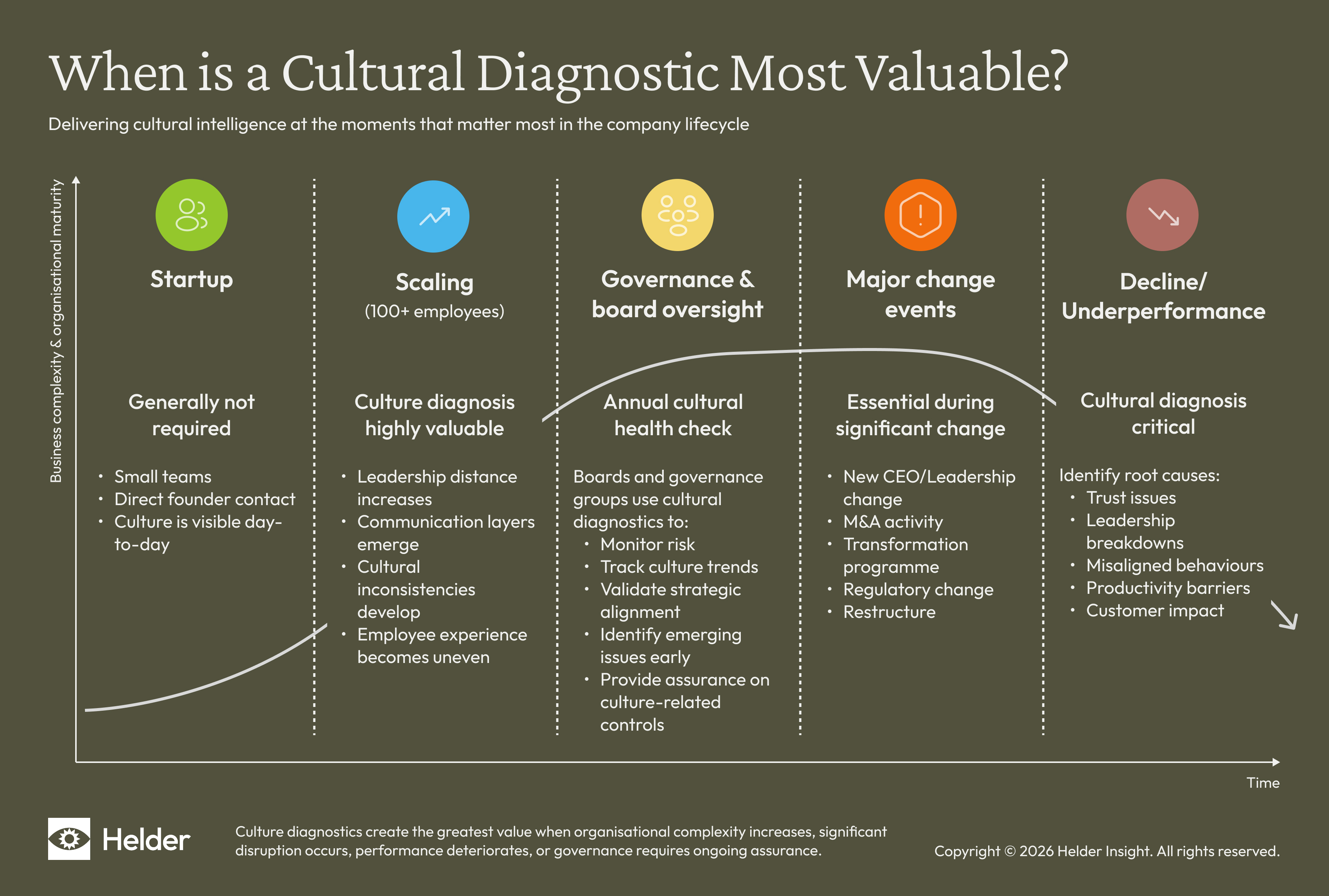
The diagram above shows the stages in the lifecycle of an organisation. Similar to finance, risk and governance frameworks, the value of cultural intelligence increases as organisational complexity increases.
Stage One: The Startup Phase
Formal cultural diagnostics generally provide less value during the startup phase - teams are small and founders remain close to their people, customers and day-to-day operations. Failures at this stage normally result from poor product-market fit, a lack of capital controls, or low levels of delivery capability.
It’s relatively easy for founders to manage cultural issues as they arise, and investors and governance groups understand the risks associated with businesses in this stage.
It’s relatively easy for founders to manage cultural issues as they arise, and investors and governance groups understand the risks associated with businesses in this stage.
Stage Two: Scaling and Growth
Once organisations begin to scale, complexity increases and the value of independent cultural intelligence scales in parallel.
Moving to greater than 100 employees becomes more challenging for founders to maintain direct contact with their people. Depending on the organisation, investors may be heavily involved meaning leaders become distracted by capital raises, road shows, reporting to investors and governance groups, with more time spent “managing up”.
Moving to greater than 100 employees becomes more challenging for founders to maintain direct contact with their people. Depending on the organisation, investors may be heavily involved meaning leaders become distracted by capital raises, road shows, reporting to investors and governance groups, with more time spent “managing up”.
Alongside this, informal conversations become harder as managers move in, adding layers and hierarchy to communications. Senior leaders begin to lose sight of what is happening further down the organisation. High-performing teams may exist alongside struggling teams, while trust and psychological safety may flourish in one team but be absent in another.
Interestingly, scaling companies formally monitor financials, fundraising, and headcount growth but many have no independent means of closely monitoring culture. Yet culture can change rapidly during periods of hyper-growth and a toxic or poorly managed culture can rapidly erode value.
This creates risk for investors and governance groups who rely on company leaders to provide accurate insights.
Pleo grew rapidly from start-up to unicorn before experiencing significant valuation pressure and multiple rounds of restructuring. Employees reported burnout and uncertainty while leadership turnover increased. The challenge was not growth itself, but the loss of visibility and control that often accompanies rapid scaling.
During Uber’s rapid growth, the CEO promoted a “win at all costs” mantra and a highly competitive internal environment. Serious cultural issues were raised by employees which eventually resulted in the CEO being forced out. While it’s difficult to directly attribute financial impacts to the toxic culture, leadership, governance and culture concerns were widely reported as contributing to a significant reduction in Uber's private market valuation during the crisis period.
Rapid growth doesn’t damage culture – it’s more that growth can outpace leadership visibility and places investors and governance groups at risk. The things that founders can observe personally in a 50-person company become increasingly difficult to see once the organisation hits 500, 1,000 or 1,500 employees.
Stage Three: Governance and Board Oversight
This stage can be deceptive – organisations are mature, management teams are stable and operational controls and risk management frameworks are embedded. During this stage, the greatest value of cultural intelligence for investors and governance groups comes from independent annual organisational health & cultural risk assessments.
Many mature organisations spend millions annually assuring the accuracy of their financial statements, cyber security, and regulatory compliance. For a major Australian or European bank this may equate to tens of millions of dollars per annum. Across the industry, assurance and audit delivers hundreds of billions of dollars in fees per year.
Yet comparatively little is spent independently assessing the cultural conditions that underpin governance, safety, conduct and performance. High-profile examples like Boeing, PwC in Australia, and Credit Suisse show that it’s dangerous for investors to assume that controls are effective when they depend on a healthy culture and employee’s feeling safe to report issues.
Financial auditing is a mature discipline supported by global standards, qualifications and thousands of specialist providers. By comparison, independent cultural assurance remains a significant blind spot, largely because culture is still regarded as difficult to measure objectively.
Unlike financial controls, culture is not self-monitoring. Organisations can continue to meet operational targets while underlying cultural conditions deteriorate unnoticed. Even in mature organisations, when culture deteriorates, employees stop speaking up, psychological safety declines, risks remain hidden and major transformations can fail.
Governance groups and investors should treat annual independent cultural health reviews as an early warning system, aiming to identifyemerging risks before they become major issues and result in people, financial or reputational damage.
Key Takeaway
Most mature organisations spend millions annually assuring the accuracy of their financial statements, yet comparatively little on assessing the underlying cultural conditions.
Stage Four: Major Change and Transformation
The value of obtaining cultural intelligence around major transformation and change events is commonly understood. Most change-mature organisations regularly use specialist practitioners to assess change readiness and outcomes before, during and after major events. These could include M&A, major tech transformation programs, restructures or regulatory changes.
Major changes place significant strain on an organisation, and changes often fail to deliver benefits on time due to cultural factors. They depend heavily on a clear view of cultural constraints. I won't discuss this phase in detail because there are many examples of major change initiatives that have failed due to cultural issues.
But here we make an addition – Helder suggests reviewing culture when a new CEO is appointed, to help to understand the cultural baseline and identify any risks that they may inherit.
When uncertainty is highest, an independent cultural review can help to provide clarity and identify potential blockers or issues.
Stage Five: Decline, Underperformance and Crisis
When business performance declines and there are no obvious reasons, it’s a good time to seek independent cultural intelligence. Warning signs may be obvious - high-performers and Execs may be leaving, product and process quality has dropped, decision making is slow and problematic, major projects fail, and regulators and the media start asking questions.
There are plenty of post-mortems highlighting the results when culture fails - but not many showing where independent reviews helped to revive a failing company. This is mostly because the findings are not made public. Credit Suisse commissioned many independent reviews throughout its’ decline, which revealed deep complexities where issues occurred over many years, with multiple concurrent scandals, and embedded conduct and culture problems. The organisation struggled to deal with these issues and eventually the regulator intervened with a sale to UBS.
While not independent, Microsoft’s Satya Nadella oversaw one of the most successful corporate turnarounds in modern history, transitioning Microsoft from a bureaucratic, siloed and internally competitive organisation by emphasising curiosity, collaboration, empathy and psychological safety.
Bucking the historic trend of non-disclosure of cultural reviews, both Rio Tinto and Yorkshire County Cricket Club commissioned external cultural reviews then published the findings. Rio’s 2022 report was brutal, but they received praise from many quarters for publicising the findings and taking ownership, focusing on remote worker camps, strict oversight and restructuring of leadership. Today Rio remains exceptionally strong but accepts it is an ongoing challenge to manage culture and safety in a complex operating environment.
Cultural Intelligence Adds Value at Key Trigger Points
The overall message is that cultural intelligence provides greater value at certain stages in the lifecycle of an organisation. Practitioners should consider aligning diagnoses with those triggers, to establish a baseline, after which treatments and change programs can be implemented with suitable monitoring.
Leaders are typically reliant on upward reporting, engagement surveys and anecdotal feedback. Independent cultural intelligence provides a separate lens, helping boards and investors validate whether what they are hearing reflects the actual experience within the organisation.
As governance groups, leaders and investors get greater visibility of the data that can be made available, independent reviews are likely to become a key component of the annual risk and assurance framework, in the same way that financial and cyber audits are today. This will be driven by trusted, reliable, validated and independent methodologies that generate clear sight of emerging risks for leaders and investors.
Regardless of the company stage, the overarching opportunity is to shift left, and measure early. Getting in early helps to embed cultural reviews as part of the organisational fabric. Leaders and their teams become familiar with the process, and understand the value that comes from independence. And the ROI associated with identifying issues early is significantly greater than the massive costs of dealing with issues that have compound into major public crises.
Cultural intelligence creates value because it gives leaders and investors something every organisation needs as it grows and changes:
The ability to see emerging risks - before they become visible as issues to everyone else.
The ability to see emerging risks - before they become visible as issues to everyone else.
If you would like to conduct an independent 'Organisational Health & Cultural Risk Assessment' get in touch.