

Blog / Presenteeism - the Invisible Productivity Drag
Presenteeism - the Invisible Productivity Drag
Presenteeism is a bigger productivity and economic problem than absenteeism yet it's much harder to measure
Andy Hamilton
6 October 2026

James Ensor, Le désespoir de Pierrot (ca. 1910). Original from the Kröller-Müller Museum.
Everyone knows what absenteeism looks like because you can see an empty desk or a person missing from an event or meeting.
It’s relatively easy to measure, and many organisations track absenteeism as an indicator of organisational health (albeit a lagging one). When all absenteeism is considered, it carries a major global economic cost, which some sources put at many hundreds of billions of dollars annually.
When someone is absent, their productivity is removed for the period they’re unavailable. When this is aggregated over time within a team, division or company it can also show where organisational issues may exist that are driving absenteeism.
But there is another “ism” that most haven’t heard of that has a larger economic and productivity impact than absenteeism. And because the person is physically there, it’s much harder to measure.
Everyone knows what absenteeism looks like because you can see an empty desk or a person missing from an event or meeting.
It’s relatively easy to measure, and many organisations track absenteeism as an indicator of organisational health (albeit a lagging one). When all absenteeism is considered, it carries a major global economic cost, which some sources put at many hundreds of billions of dollars annually.
When someone is absent, their productivity is removed for the period they’re unavailable. When this is aggregated over time within a team, division or company it can also show where organisational issues may exist that are driving absenteeism.
But there is another “ism” that most haven’t heard of that has a larger economic and productivity impact than absenteeism. And because the person is physically there, it’s much harder to measure.
It's called 'Presenteeism'.
Presenteeism is commonly known as working while physically or psychologically unwell. I think this oversimplifies the definition because it doesn’t consider people who are at work, and who are capable of working, but are unable, unsupported or no longer motivated to contribute at their normal capacity. The former considers employees turning up sick - while the latter is the result of often avoidable organisational and structural factors that contribute to presenteeism.
Either way, they all have the same organisational symptom: an employee is physically at their desk or logged into their remote workstation but is functioning at a fraction of their potential.
The Difference Between Absenteeism and Presenteeism
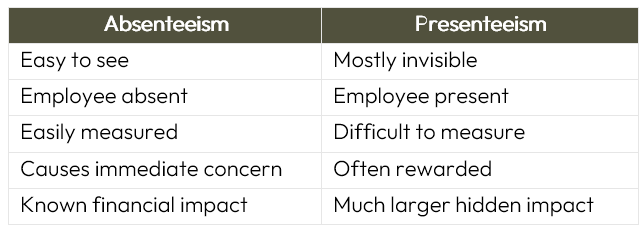
Organisations have spent decades measuring absenteeism. They know exactly who is absent and for how long because it’s easy to measure - and employees generally contact their manager when they can’t come in.
Presenteeism is much harder to identify. Employees deliver materially less output while remaining fully represented in payroll and attendance data.
Presenteeism is much harder to identify. Employees deliver materially less output while remaining fully represented in payroll and attendance data.
How Big is the Presenteeism Problem
Part of the challenge with understanding the impacts is there is no universal breakdown of productivity loss. However, research consistently indicates that impaired performance while people remain at work can equal or exceed the visible cost of sickness absence, with figures estimating anywhere between 1.5-4x the costs of absenteeism.
Across multiple measures, the cost is substantial and largely hidden.
And what makes presenteeism particularly problematic is that is has the potential to compound. A disengaged manager can affect an entire team while a culture that normalises exhaustion gradually reduces organisational capacity at scale.
Across multiple measures, the cost is substantial and largely hidden.
And what makes presenteeism particularly problematic is that is has the potential to compound. A disengaged manager can affect an entire team while a culture that normalises exhaustion gradually reduces organisational capacity at scale.
Estimated National Costs
Its difficult to put a number on presenteeism costs – we have some annual metrics below, but they’re not a like-for-like comparison as they cover different years, definitions and calculation methods.
Australia:
- Estimated Presenteeism = A $35bn
- Estimated Absenteeism = A $33bn
Netherlands:
- Alcohol related presenteeism = Euro 2.4bn when hungover compared to Euro 235min alcohol absences
UK:
- Health related presenteeism = GBP 21.0bn
- Estimated Presenteeism = A $35bn
- Estimated Absenteeism = A $33bn
Netherlands:
- Alcohol related presenteeism = Euro 2.4bn when hungover compared to Euro 235min alcohol absences
UK:
- Health related presenteeism = GBP 21.0bn
The Productivity Cost to Business
While it might seem like a dedicated worker is helping the company, studies including research highlighted by the Harvard Business Review show that presenteeism hurts businesses.
- Productivity and Innovation Loss: Output reduces where employees work through illness, exhaustion or severe disengagement, sometimes doing the bare minimum.
- Mistakes and Quality Issues: Exhausted, stressed or strategically confused workers are more likely to make errors requiring rework, intervention from seniors or leading to customer complaints. They can also result in safety issues.
- Reduced Team Morale & Performance: Leadership-driven presenteeism can impact an entire team, when they see the progress of others impacted by poor management or unclear strategy.
- Aggravated Burnout and Attrition: Forcing employees to operate under poor managers or to work through illness accelerates severe burnout. Eventually, this can lead to psychological presenteeism and extended absence or unwanted turnover with associated costs.
What are the Drivers of Presenteeism
There are several drivers of presenteeism, it doesn’t just happen“because employees suddenly lose interest in working”:
- Poor leadership, including micromanagement, which can cause employees to withdraw effort or switch into survival mode.
- Lack of psychological safety, where people feel unable to raise ideas, concerns or take interpersonal risks.
- Job insecurity, which can reduce discretionary effort.
- Unrealistic performance expectations that gradually demotivate people.
- Inadequate staffing and organisational design, contributing to exhaustion, burnout and lost productivity.
- Always-on digital cultures that reward visible activity rather than meaningful contribution.
- Poorly designed incentives and operating models that reward one part of an organisation (e.g., front loaded to sales) while transferring unrealistic product features and risk to support functions causing pressure, stress and burnout.
Employees often respond rationally to irrational environments. When people feel they cannot safely disengage, recover or speak up, presenteeism becomes normalised.
The View from the Ground
Having freelanced for a large part of my career across more than a dozen organisations I have seen first-hand the causes of presenteeism. An Exec who unknowingly created a psychologically unsafe environment through erratic behaviour stifled innovation and led to reduced output due to fear of public humiliation.
In other cases, on-going restructures created job insecurity and anxiety that impacted productivity, while in the worst cases, unsupportive management plus unrealistic targets caused burnout and unwanted turnover.
In other cases, on-going restructures created job insecurity and anxiety that impacted productivity, while in the worst cases, unsupportive management plus unrealistic targets caused burnout and unwanted turnover.
Why isn't Presenteeism More Widely Understood
Outside HR, occupational psychology and workplace wellbeing circles, the term "presenteeism" is largely unknown. Many people actively engage in it every day without recognising it. For generations, employees were taught that showing up no matter what shows commitment. And working late or answering emails at midnight showed loyalty and demonstrating resilience.
Some people can switch off quickly and cope with this kind of behaviour for extended periods, but over time it risks exhaustion and burnout. An employee who is physically present but mentally exhausted is rarely operating at peak performance. Errors increase. Decision quality declines. Creativity falls. Customer interactions suffer. Yet because the individual is "at work" the problem can be invisible to leaders and colleagues.
Some people can switch off quickly and cope with this kind of behaviour for extended periods, but over time it risks exhaustion and burnout. An employee who is physically present but mentally exhausted is rarely operating at peak performance. Errors increase. Decision quality declines. Creativity falls. Customer interactions suffer. Yet because the individual is "at work" the problem can be invisible to leaders and colleagues.
What Leaders Should Look For
Executive blind spots often conceal presenteeism. Leaders should consider actively monitoring these indicators:
- Velocity Decay: Slower strategic decision-making and delayed project deliveries.
- Activity vs. Outcome Disconnect: The appearance of a "high digital presence" or continuous online activity paired with stagnant outputs.
- Quality erosion: Spikes in error rates, delayed delivery and customer complaints
- The "Quiet" Paradox: Unusually low levels of absenteeism alongside declining team energy and rising burnout reports.
I will discuss options for measuring culture in a future blog, while the metrics above can show that presenteeism may be present, they are either lagging or only show what is happening, but not why.
How Helder Identifies Presenteeism
At Helder we map the root environmental causes of productivity drag, using an initial cultural health scan to assess whether an organisation has elevated indicators of presenteeism, productivity drag and value leakage.
Those initial insights inform direct, one-to-one conversations with employees and leaders, because we understand the value of being human. Data is then processed via our Three Factor MethodologyTM to show why high presenteeism might exist, focusing on stuctural and organisational factors.
Helder's methodology, providing cultural intelligence and organisational diagnostics, helps leaders to 'shift left' and adopt preventative measures to reduce presenteeism. These insights can improve employee wellbeing and job satisfaction while increasing productivity and organisational value.
Those initial insights inform direct, one-to-one conversations with employees and leaders, because we understand the value of being human. Data is then processed via our Three Factor MethodologyTM to show why high presenteeism might exist, focusing on stuctural and organisational factors.
Helder's methodology, providing cultural intelligence and organisational diagnostics, helps leaders to 'shift left' and adopt preventative measures to reduce presenteeism. These insights can improve employee wellbeing and job satisfaction while increasing productivity and organisational value.
Why this Matters to Leaders, Investors and Employees
Presenteeism is often viewed as a people problem. In reality it’s a productivity, governance, value creation and societal issue.
Identifying and addressing the root causes of presenteeism has many benefits, far above financial improvements (remembering that in Australia alone, the annual cost of presenteeism is estimated at $35bn).
Healthy organisational cultures with reduced presenteeism create value for multiple stakeholders:
Identifying and addressing the root causes of presenteeism has many benefits, far above financial improvements (remembering that in Australia alone, the annual cost of presenteeism is estimated at $35bn).
Healthy organisational cultures with reduced presenteeism create value for multiple stakeholders:
- For Boards and Governors: Mitigates hidden psychosocial hazards, ensuring compliance with strict director liability risks and proactive governance frameworks.
- For CEOs and HR Practitioners: Shifts the organization from a reactive crisis-management stance to a proactive "shift-left" culture, unlocking hidden capacity without increasing headcount.
- For Investors and shareholders: Recaptures latent EBITDA trapped inside structural inefficiencies, providing a clearer look at factors affecting long-term value creation.
- For Governments and taxpayers: helps give greater visibility into whether teams and departments are set up to deliver sustainable value to the public.
- For Employees: helps organisations to build environments where people can contribute meaningfully, develop professionally, recover effectively and maintain energy for their families, communities and personal lives.
What looks like a people issue may also be a governance risk, a compliance consideration, an investment signal, an opportunity to create healthier workplaces, and a source of latent EBITDA.
Preventative diagnostics can help to understand the current state so that a baseline can be established, and remediation plans set in place to mitigate emerging risks.
The opportunity across all stakeholder groups is significant. Applying purely a financial lens, in Australia alone, reducing presenteeism by 5% could equate to a total annual benefit of $1.6bn.
Preventative diagnostics can help to understand the current state so that a baseline can be established, and remediation plans set in place to mitigate emerging risks.
The opportunity across all stakeholder groups is significant. Applying purely a financial lens, in Australia alone, reducing presenteeism by 5% could equate to a total annual benefit of $1.6bn.
Key Takeaway
Presenteeism is an avoidable and invisible productivity drag that has major impacts to organisational performance and employee wellbeing outcomes.
Final Thoughts
Presenteeism may be one of the most misunderstood cultural concepts in modern business. Most leaders can identify who is absent. Far fewer can identify who is present but struggling, or determine the reasons why. That hidden group may represent a substantial source of lost productivity, diminished wellbeing, organisational risk and unrealised value.
The challenge for leaders is not simply getting people to work. It is understanding the factors within their environments that are preventing them from delivering sustainable performance.
The greatest threat is not always the empty desk - it may be the occupied one.
If you would like to discuss presenteeism and how we can help you identify its drivers within your organisation get in touch.