Before I started working on my PhD, and hadn’t yet decided on a topic, I kept coming across troubling stories in the media about what it was like working in law firms. Common themes included bullying, harassment, poor wellbeing and toxic work environments. At first, much of what I was reading was coming out of New Zealand and Australia. But as I started reading more widely, I realised these concerns extended far beyond New Zealand and Australia. Similar issues were being reported in law firms around the world, alongside high levels of employee turnover.
It left me with a practical question: What role do leaders play in creating workplaces where people feel psychologically safe, particularly when the work itself is demanding, and the environment is very hierarchical?
I decided that law firms would be an interesting context to study the impact of leadership and psychological safety on wellbeing outcomes.
Across three studies, I explored the relationship between leader behaviours, psychological safety, employee wellbeing, resilience and people's desire to stay or leave their organisation. I was particularly interested in hearing real-life experiences in these workplaces that I'd read so much about in the media. What emerged was a far more complex picture of psychological safety than simply whether people feel comfortable speaking up or not.
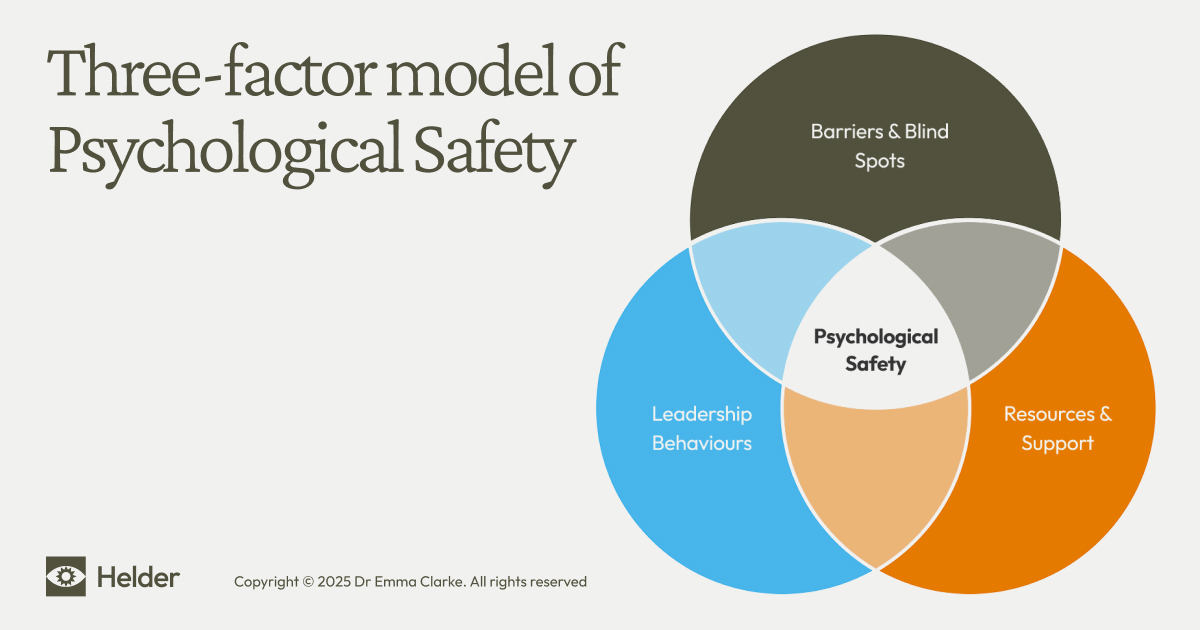
When I finished my PhD and we decided to start Helder Insight, I needed to make my academic research more accessible to business leaders and more useful in practice. By bringing the findings from my three studies together, I developed what is now called the Three-Factor Model of Psychological Safety™.
At its heart are three interconnected factors:
- Leader Behaviours
- Barriers to Psychological Safety
- Resilience-Enabling Resources
1. Leader Behaviours
Perhaps unsurprisingly, leaders matter.
My research found that behaviours such as empathy, fairness, honesty, vulnerability and being receptive to feedback helped foster psychological safety. So did building trusting relationships with employees, addressing concerns fairly and promptly, providing constructive feedback and recognising when someone was struggling. Many of these behaviours are associated with emotional intelligence, particularly empathy and self-awareness.
But what was particularly interesting was the importance of how employees experience those behaviours. A leader might genuinely believe they are approachable, and they might tell their team that their door is always open. But that doesn't necessarily mean employees experience the relationship in the same way.
- What happens when someone actually walks through that door with a difficult problem?
- How does the leader respond to mistakes?
- What happens when someone disagrees with them?
- How do they react when they are under pressure themselves?
Those experiences send powerful signals about what is and isn't safe within a team.
My research also highlighted the importance of role modelling. Employees learn by watching the people around them, particularly those in positions of authority. How leaders behave when things go wrong can be just as important as what they say when things are going well.
2. Barriers to Psychological Safety
Even a well-intentioned leader can operate within a system that makes psychological safety difficult. Formal and informal hierarchy, workplace politics, rude and disrespectful behaviour, confidentiality concerns, performance pressures, bias and fear of career consequences can all influence whether someone feels able to speak honestly.
And this was where leader blind-spots were revealed.
In my research, leaders and non-leaders sometimes had completely different perspectives about the workplace. Leaders might believe employees felt comfortable speaking up, while employees described not feeling safe to speak up in case it impacted their reputation or career. Leaders might identify workload and long hours as the primary source of employee stress, while employees described other pressures, including emotional demands from clients, workplace relationships or poorly designed organisational systems.
Those differing perspectives matter.
If leaders don't know what is really driving stress and burnout, silence or unwanted turnover, it becomes difficult to address the underlying problem. It also means that silence shouldn't automatically be interpreted as a sign that everything is fine. Silence doesn’t necessarily mean there isn’t a problem. Sometimes, it means people have learned that staying silent is safer and better for their career.
Gender differences also emerged from my research. Gender bias became a leader blind-spot because the underlying issue is one of barriers and unequal access to resources, opportunities and support.
This is an important reminder that people working in the same organisation don't necessarily experience its culture in the same way. Our perceptions of the workplace can be shaped by many things, including previous work experiences, gender, age, ethnicity, seniority, and tenure. So we shouldn't assume that one person's experience of the work environment are the same as everyone else's.
3. Resilience-Enabling Resources
The third factor came from looking at the relationship between psychological safety, resilience and employees’ decisions about whether to leave or stay.
Individual resilience and organisational resilience are not the same thing. While people may develop strategies to cope with pressure, in high-demand workplaces the environment matters too.
Employees are more able to cope with difficult situations when they have access to resources such as supportive leaders, autonomy, flexibility, opportunities to learn, and good workplace relationships. Psychological safety matters because it affects whether people feel able to use those resources.
For example, an employee assistance program (EAP) may exist, but that doesn't necessarily mean someone will use it if they need it. Flexible working can be available on paper, but employees may still believe that using it will damage their career prospects. A leader can offer support, but an employee may have learned from previous experience that admitting they are struggling will be interpreted as an inability to cope. So an important distinction is not simply whether resources exist, but whether they are accessible, appropriate and psychologically safe for employees to use.
It is the interaction between the three factors that matters. This is probably the most important part of the model. The three factors don't operate independently.
A supportive leader can strengthen psychological safety, but organisational barriers may still prevent someone from speaking openly. An organisation can provide wellbeing resources, but excessive demands or fear of being judged may prevent people from using them. Equally, when people have supportive relationships, appropriate resources and an environment in which they can ask for help, they may be better able to cope with difficult experiences, recover from them and learn from them.
Over time, these experiences can become reinforcing.
Support can encourage help-seeking. Help-seeking can enable learning. Learning can build confidence and expertise. Positive experiences of asking for help can strengthen trust and make someone more willing to speak up the next time something goes wrong.
The opposite can happen too. Sustained pressure can deplete people's resources. When psychological safety is low, someone who is already struggling may be even less likely to ask for help. They may withdraw, remain silent or try to manage alone. Eventually, leaving can become one way of protecting themselves.
That is why resilience in high-demand workplaces cannot be understood purely as an individual characteristic. We also need to ask what the organisation and its leaders are doing to enable resilience.
Beyond law firms
Although my PhD research was conducted in professional services firms, I don't think the underlying mechanisms are absolutely unique to law firms.
There are certainly differences between industries and professions in their job demands, pressures and stressors. But there are also many similarities. Workplaces often combine high expectations, reward mechanisms, hierarchy, demanding stakeholders, consequential decisions, complex work and sustained pressure. It’s the form of those pressures that sometimes differ.
For example:
- Billable-hour targets become utilisation rates, caseloads, productivity measures, response times, or performance targets.
- Law firm partnerships might become clinical, technical, academic, or executive hierarchies.
- Clients might become patients, passengers, students, internal or external customers or communities.
The context changes, but the underlying questions remain remarkably similar:
- What are leaders doing that makes it easier or harder for people to speak openly?
- What structural or cultural barriers are getting in the way?
- And do people have the resources they need to cope with the demands being placed on them?
From research to practice
The Three-Factor Model™ became a way of bringing together what I had learned during my PhD and translating those findings into something that could be used by practitioners and senior leaders of organisations. It now provides the research framework underpinning our work at Helder Insight.
Rather than looking at psychological safety as an isolated score, we use the model to examine the underlying leadership behaviours, organisational barriers and resilience-enabling resources shaping people's experiences at work. Because ultimately, knowing that psychological safety is low, or that wellbeing or engagement is declining, only takes you so far.
If people in your organisation aren't feeling psychologically safe, how would you know? And how would you know what was getting in the way?
In a future blog, we’ll explore why psychological safety is foundational to a positive working environment, why it has traditionally been difficult to measure, and what this means for organisations trying to understand what is really happening beneath the cultural surface.
If you would like to identify the factors in your organisation impacting work culture get in touch.