
(Pic taken at dusk, cycling near Monnickendam in the Netherlands)
While taking Helder to market, Emma and I often debate how to meaningfully measure culture when we are in an era obsessed with AI, and rapid, scaled data. There are so many data points available – what should be measured, how, when, and whether internal or external measurement is best?
Culture is Difficult to Measure
Researchers have encountered an important issue when it comes to assessing the impacts of cultural change – that there is no common definition of what culture actually is. Barends, E. and Rousseau, D. (2022) Organisational culture and performance: an evidence review illustrate this in their review of 700 papers between 2000 and 2021, assessing the link between culture change and performance. While 78% of Fortune 500 CEOs claimed there is a strong link between culture and performance, academic research struggles to confirm this. Barends and Rousseau’s review found that culture is a deeply rooted concept preferred by business leaders, but it has no consensus definition, it is exceptionally hard to measure, and there is no reliable evidence from the published papers that there is a strong link between culture change and performance. They note that this is heavily impacted by the quality of the research – mostly rated medium to low quality in terms of the methodologies and ability to replicate.
To address this vagueness, Barends and Rousseau propose narrowing the focus from the broad term of culture to organisational climate defined as the specific, shared perceptions of lived policies, practices, and observable behaviours. Their view is that climate is much easier to measure and can be directly connected to managerial actions. Managers have more control over their local climate, while culture is more intangible and difficult to shift.
Organisational climate as a useful analogy: we can easily measure current conditions (look out the window), observe changing signals (wind and cloud formations) and assess what’s potentially on the way. But, like weather, prediction becomes harder the further ahead we try to look. What we can do however, is combine signals and assess risk.
I’ll come back to that – but focusing on recent history, will first discuss the types of workplace assessments that are available, how they have changed over the last 10yrs and where we are heading.
What Can we Actually Observe?
Organisations typically assess culture through one or more of quantitative, qualitative and behavioural methods. Each have their strengths and weaknesses depending on their purpose and where they sit within a broader cultural strategy.
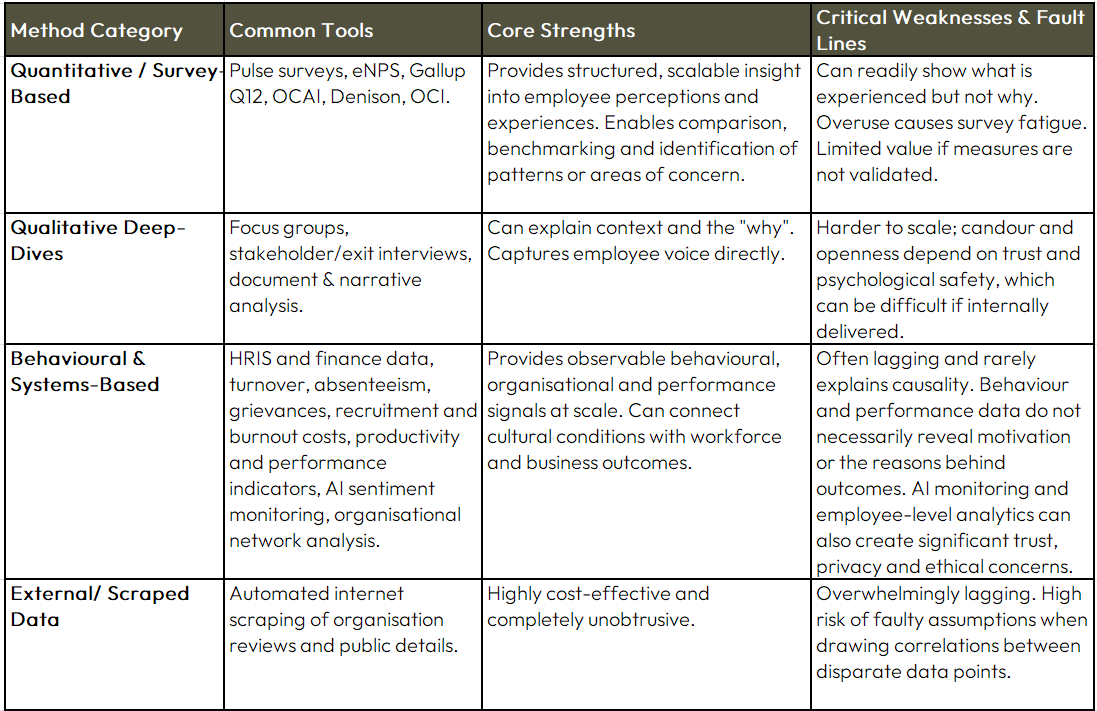
Each method brings different strengths and limitations. Some are rapid and unobtrusive but offer limited insight, while qualitative approaches provide greater depth but have traditionally required considerable time and resource. Trust may also depend on who conducts the assessment, whether it is managed internally or independently, and how the data is analysed. Importantly, methods that are effective at measuring the current climate may still have significant limitations when it comes to understanding what is driving it and why.
More Data Hasn't Solved the Problem
The amount of data has changed dramatically over the last 10 years, along with the measurement methods.
Looking at more recent times, pre-COVID, organisations tended to monitor culture via a large annual snapshot targeting active engagement scores like Gallup or early Culture Amp. Data was lagging, and slow-moving.
During COVID, remote and later hybrid working meant leaders needed rapid visibility, partly because they couldn’t walk the floor – so the measurement focus switched to the “pulse on wellbeing”. Wellbeing apps and surveys, measuring engagement, burnout risk and belonging, became prevalent. Many HR budgets are still caught in contracts that arose from COVID-era “culture platforms”, with many now questioning the value delivered from tools heavily focused on employee experience, rather than identifying the organisational factors that contribute to that experience.
In the last 2-3years, the availability of large data sets, progress with AI and enhanced analytical methods has driven an “always-on and passive listening” phase. Organisations can now readily supplement periodic surveys with continuous signals monitoring collaboration, communication, workload and organisational tension – essentially the current climate. This is also allowing organisations to pivot away from 3rd party platform vendors to build their own internal measures using AI.
It’s an attractive proposition, but carries a risk where a lot of effort can be invested in building measures that again only focus on the now, and the employee experience. They may show periods of stress and pressure, but with risks (e.g., privacy concerns along with changes in employee behaviour when they know they are being monitored). Employees need to feel comfortable that passive metrics are being used to support their focus – not to micromanage their time.
Modern methods can capture large data sets, but correlating relationships between variables doesn't explain causality.
It can tell us where to look, and more and more we can see what’s going on, but it doesn’t help to explain why. Understanding why those patterns exist still requires context, enquiry and interpretation.
This creates what I think of as the predictive culture gap: the growing distance between our ability to collect signals about what is happening inside organisations and our ability to reliably explain why it is happening, what it may lead to, emerging risks, and what leaders should do about it.
When to Measure
We’ve discussed when to measure culture in a previous blog. While that blog focused on workplace diagnostics, in the same vein, practitioners and leaders need to select from the methods above that suit their objectives at the time.
I had an insightful conversation with an outgoing CEO recently who felt it wasn’t the right time to conduct a health scan because they were about to change CEOs. Plus the organisation was transitioning its legal structure. They felt it would be much better to conduct a scan when things had settled down.
While waiting is an option, the incoming CEO could benefit from understanding inherited cultural risk, while providing the board with a baseline to assess change in people experiences over time, correlated with organisational performance.
Did the new structure and leader drive the right outcomes?
Sometimes the least comfortable time to measure is precisely when establishing a baseline has the greatest value.
Who Measures Can Impact the Evidence
The question of who conducts cultural assessments, how the data is analysed, and the impact on outcomes, is surprisingly underestimated – organisations often take the easy path, collecting data internally because it gives more control over the scope of questions, frequency, analytics, costs, and reporting to management and boards.
Internal assessment carries an inherent risk. Research indicates that employees may be less willing to speak openly and honestly unless anonymity and confidentiality are guaranteed. The introduction of AI listening tools can help organisations detect silence but at the same time create conditions that produce it. Even with third-party tools, people who believe they can be identified will calculate the risk and reward of answering honestly.
Internal reporting creates another layer. Findings can become progressively aggregated, reframed, or contextualised as they move through management before reaching the board. Independent collection isn't automatically more accurate either: employees may still ask who commissioned the work, what will be reported, and whether the data is genuinely anonymised.
How we observe can change what is observed. Collection design therefore becomes part of measurement validity.
What are Leaders, Governors and Investors Really Looking For?
Ultimately, they want to know where cultural strengths or risks may be emerging that could erode value or increase exposure to liability: declining trust, suppressed employee voice, incivility, burnout, unwanted turnover or organisational friction. And they need enough confidence in the evidence to decide whether to act.
Why is reliable measurement and analysis important? Because it serves as an early-warning system for systemic friction, toxic subcultures, and burnout risks before they become costly post-mortems. And when they are managed internally, they can introduce risks that undermine both trust and value.
Poor workplace culture is not simply a people issue; it can create significant organisational and financial risk. Unwanted turnover, leadership disruption, reduced productivity, complaints, investigations and external reviews can all carry substantial costs. The value of assessment therefore lies not just in describing the current climate, but in identifying emerging cultural risks and their underlying causes before they become more costly problems.
No Single Lens is Enough
As the methods and data show, there is no silver bullet for assessing culture. Borrowing from academia, the consensus is that better insights can be obtained by combining metrics, applying a mixed-methods approach, and focusing on conditions, perceptions, behaviours and organisational signals that can highlight emerging risks. Surveys can tell us one thing, organisational data another, and lived experience something else. Sometimes those signals reinforce one another; sometimes they contradict each other. Sometimes those contradictions raise the most useful questions.
The culture measurement problem has changed. It's not that we don't have enough data. It's determining what data is most relevant, what should be discarded, and which signals are meaningful. Then understanding why they exist, and deciding whether the evidence is independent and trustworthy enough to act upon.
That is where cultural measurement starts becoming cultural intelligence.
In future articles, we'll look at how a mixed-methods approach can create a more reliable baseline for cultural measurement. By independently triangulating employee voice, validated survey measures and hard organisational indicators, we can build a deeper picture of organisational culture. Then supplementing the baseline through regular monitoring of organisational climate.
If you would like to discuss ways of measuring culture in your organisation, or if you're a practitioner, with your clients, get in touch.